Life Safety / JAY CLOUD JOURNAL
Why Your Manufacturing Facility Can’t Produce a Reliable Headcount in an Emergency
Emergency headcount. OSHA 1910.38 compliance. The integration gap none of your systems were built to close.
Poksundo Team ·
The alarm goes off. Now what?
The fire alarm trips at 6:47 AM. Chemical release, Zone 4. Evacuation underway and emergency responders are pulling into the lot.
Your safety officer needs one answer immediately: who is on the floor right now, how many, and where?
Three systems are open on three different screens — your HCM, your badge reader, your contractor log. OSHA's own evacuation guidance is direct: employers must “identify the names and last known locations of anyone not accounted for and pass them to the official in charge or to emergency responders”
Three systems. None of them can meet that standard alone — or together. We'll explain why this gap exists, and how you can easily unify this with a simple cloud solution.
Your HCM, your badge system, and your visitor log are all telling you different things
HCM — SAP SuccessFactors, Workday, HiBob & other common platforms
Know who was scheduled for today’s shift. It doesn’t know who actually arrived, who left early, or who is currently in a confined space on the east side of the building.
Badge System
Knows who entered the facility this morning. It doesn’t know who left before the alarm, who moved between buildings, or who is in the break room versus on the production floor.
Contractor and Visitor Log
Often a paper sheet on the security desk — the most incomplete record of all. The service technician who badged in at 5:30 AM signed the sheet. There is no reliable record of whether they are still on-site.
The problem isn’t that the data doesn’t exist. It’s that it lives in three disconnected places, none of them designed to talk to each other, and reconciling them manually takes time that emergency responders don’t have.
"If time isn’t validated at the point of entry, it isn’t reliable.”

What actually happens when a manufacturing facility evacuates
Emergency responders arrive and ask the same question every time: how many people should be here, who is missing, and what was their last known location?
What you hand them: a shift roster from yesterday’s HCM sync, a badge-in log that hasn’t been reconciled against exits, and a contractor sign-in sheet that may or may not reflect who is still on the floor. Three partial answers. Not one reliable list.
The contractor blind spot is where this gets dangerous. The person who badged in to service the hydraulic press in Bay 7 is not in your payroll HCM. They’re on a paper sign-in sheet. If that sheet is wrong or incomplete, they don’t exist in your headcount.
Every minute your safety officer spends reconciling three disconnected lists is a minute emergency responders cannot act with confidence. In manufacturing environments — heavy equipment zones, chemical storage, confined spaces — “probably accounted for” is not an operational standard.
The scale of the risk is real. U.S. manufacturing recorded 220,000 injury and illness cases in 2024, the third-highest total of any industry sector (BLS/OSHA, April 2025). The fatal work injury rate held at 3.3 per 100,000 full-time equivalent workers. These are the conditions under which your headcount process has to work — not ideal conditions, not a drill.
“You can’t ensure safety without knowing who is actually on-site.”
OSHA 1910.38 doesn’t ask for your best estimate
OSHA 29 CFR 1910.38 requires any employer with 10 or more employees to maintain a written Emergency Action Plan. That plan must include explicit “procedures to account for all employees after evacuation” — not a best-effort reconciliation, a documented and repeatable procedure.
The regulation requires employers to identify missing persons by name and last known location and pass that information to emergency responders. It assumes a unified, real-time record. It does not accommodate a manual sprint across three disconnected systems while a building is on fire.
The word “all” in 1910.38 matters. Contractors, temp workers, and service technicians are included. If they are in the building and not captured in your headcount system, your Emergency Action Plan does not satisfy the regulation — regardless of what the written EAP says the process is.
Most manufacturers have a written EAP that references “badge system and shift roster” as the accountability method. The gap isn’t in the paperwork. The gap is that those systems don’t integrate, so the described process doesn’t function reliably during a live event.
One market signal worth noting: in December 2025, Brivo launched voice-activated emergency lockdown for access control — site-wide lockdown via voice or text command. It’s a clear signal that the access control industry is moving toward integrated emergency response. But lockdown and mustering are different problems. A facility can execute a flawless lockdown and still not know who is trapped inside. The headcount gap 1910.38 requires you to close remains unsolved by that product direction.
Anchor your compliance exposure to 1910.38. The requirement is specific, it covers all personnel, and it describes a standard your current disconnected systems cannot reliably meet.

Closing the gap between who entered and who’s on the floor right now
The individual systems aren’t broken. Your HCM does what it was designed to do. Your badge system does what it was designed to do. The problem is a category gap — none of them were built to produce a real-time on-site headcount, and they were never designed to talk to each other.
A Workforce Presence Validation Layer sits between your HCM, your access control system, and your visitor and contractor management — connecting them so there is one list, not three competing partial records.
jay cloud connects SAP SuccessFactors, Workday, HiBob, and other popular solutions to physical access data and visitor and contractor records across four product areas: Time, Access, Visitor, and Life Safety.
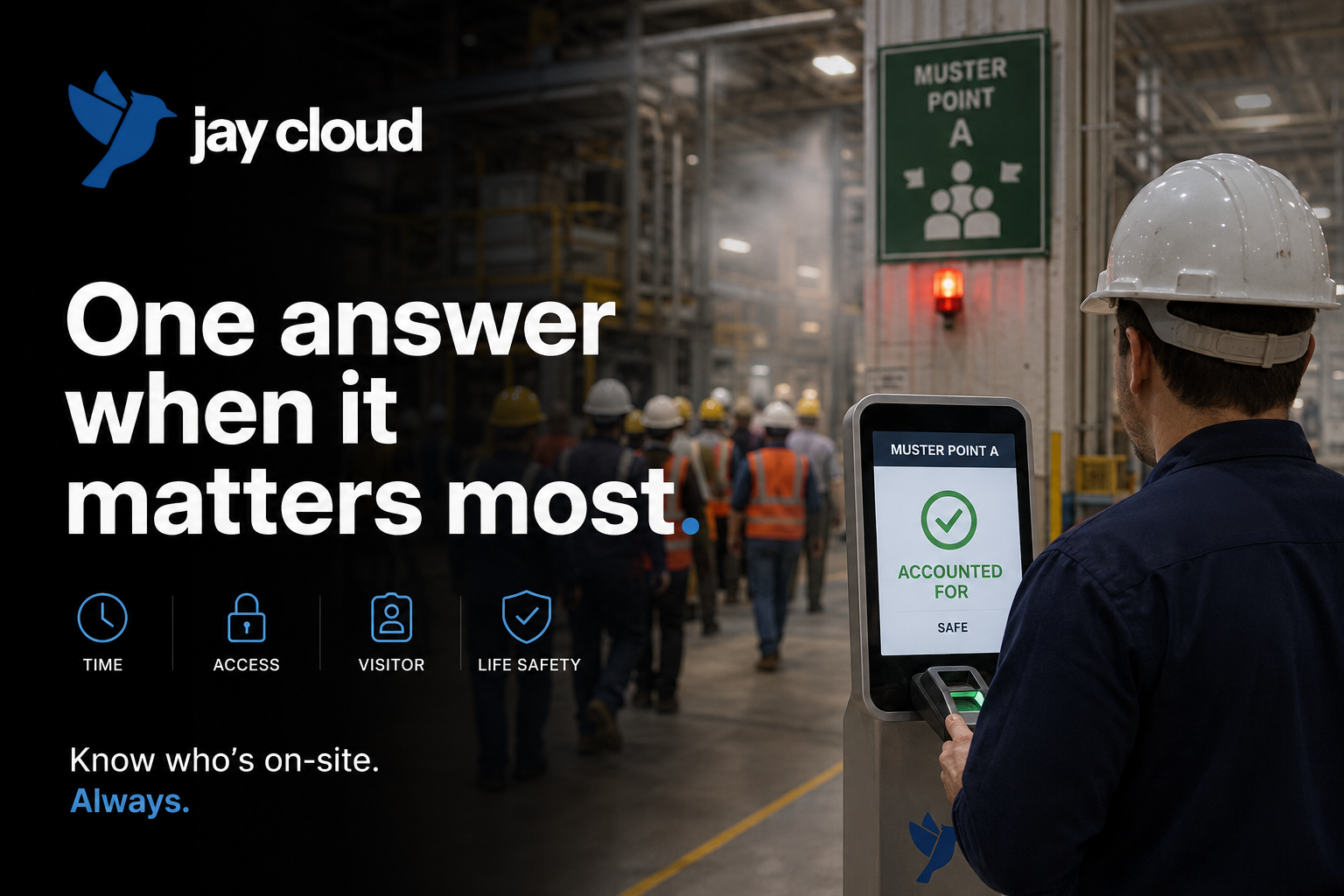
The difference shows up most clearly at the assembly area. As workers muster, intelligent muster points — RFID and biometric readers at the terminal — confirm each person as safe in real time. No manual count. No clipboard. The dashboard produces one validated list: who is on-site, who is confirmed safe, and who is still unaccounted for — by name.
- This is not an upgrade to your badge system or your HCM. It is the integration layer that closes the gap those systems leave open by design.
The same system that accounts for emergencies also validates every shift
Solving the emergency headcount problem doesn’t only pay off during emergencies.
- The contractor blind spot closes permanently — on every shift, not just when the alarm trips.
- When time is validated at the point of physical entry rather than through self-reported clock-in, payroll and labor accuracy improve as a downstream consequence.
The case for presence validation starts with knowing who is on your floor when it matters most. Everything else follows from that.

See how it works in a manufacturing environment
If your Emergency Action Plan relies on reconciling your HCM, your badge system, and a paper contractor log under pressure — it’s worth seeing what a unified presence validation layer looks like in practice.
Book a Demo → Walk through what an intelligent muster point looks like when the alarm trips, and how jay cloud connects your existing systems to produce a reliable, real-time headcount.