Time / JAY CLOUD JOURNAL
Time and Attendance for Manufacturing: Shift-Work Guide
Improve time and attendance for manufacturing with HR-driven shift rules, floor terminals, stronger clock-in controls and cleaner payroll inputs.
Poksundo Team ·
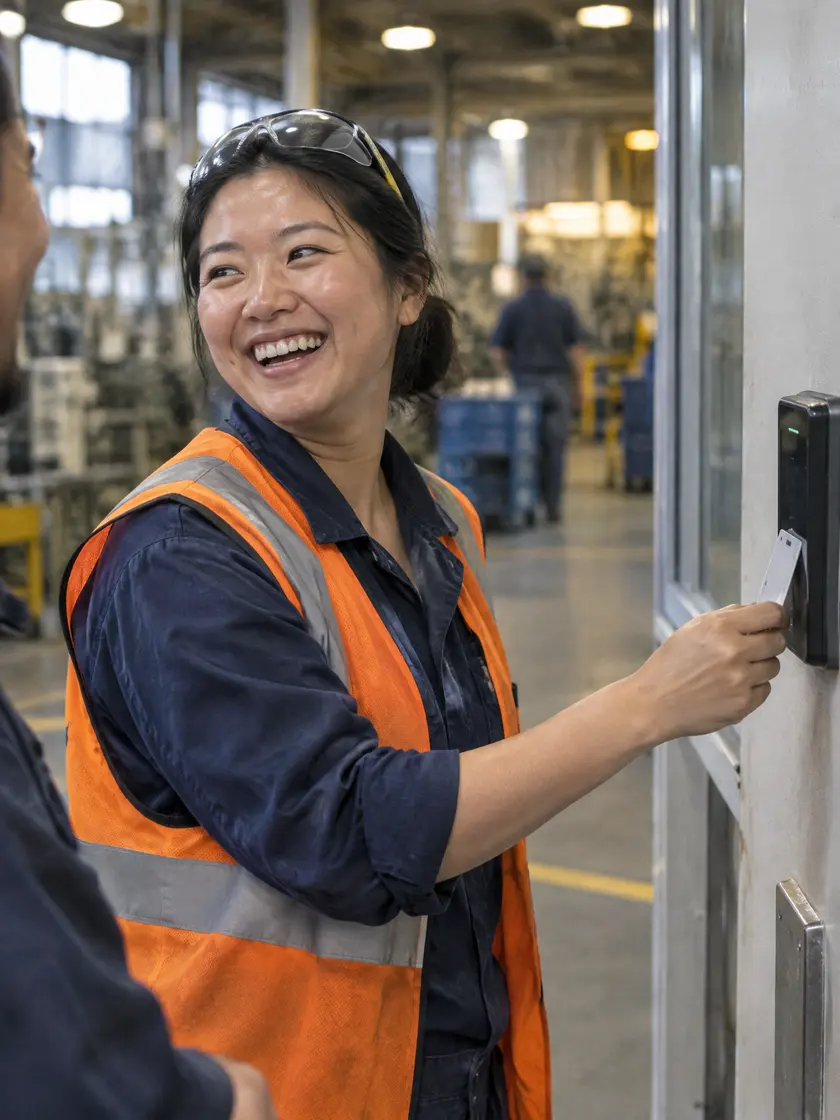
Time and attendance for manufacturing works best when employee records and shift rules come from HR, workers can record time reliably on the floor, and exceptions are resolved before payroll. Badge entry and paid working time should remain distinct: an access event can help validate a time record, but it does not automatically prove someone started work. The practical goal is accurate, explainable records across employees, shifts and contractors.
Why time and attendance for manufacturing needs a connected approach
A factory has more moving parts than a standard office timekeeping setup. Workers change departments, rotate between shifts, enter restricted areas and sometimes work across midnight. Contractors may share entrances with employees while following different authorization and payment processes.
Disconnected records make those differences harder to manage. HR may show a department transfer while a local access list still reflects the old assignment. A time record may show a clock-in without enough context to explain whether the worker entered the site or used the wrong terminal.
The answer is not to make one event stand for everything. It is to connect workforce identity, time recording and physical access while preserving their different meanings. That gives HR, operations and security a common starting point for investigating discrepancies.
Start with HR data and explicit shift rules
Before selecting terminals, agree on which system owns employee status, department, location and other attributes used in workplace rules. Otherwise, the same transfer or departure can require updates in several places, with no clear authority when records conflict.
jay cloud by Poksundo is a connected layer for Time, Access, Visitor and Life Safety, driven by HCM data. Its five native HCM connections are SAP, Workday, HiBob, Hubdrive and Access People. Its stated workflow synchronizes workforce data and derives access rights, shift models and visitor policies from HR data.
For manufacturers, the useful design question is how each HR attribute should affect the workplace. A department assignment might inform access to a production area; a shift assignment might inform the applicable time-recording rules. Those mappings should be documented and tested rather than assumed.
Build a rule inventory that covers:
- Fixed, rotating and overnight shifts.
- Transfers between departments or sites.
- Temporary assignments and employment-status changes.
- Early arrivals, late departures and missed punches.
Separately document how breaks, overtime and shift premiums are handled downstream. HR-driven shift models do not, by themselves, establish which system calculates every payroll rule. Confirm those responsibilities during evaluation, and confirm working-time obligations with counsel.
Put terminals where work actually happens
Manufacturing time collection should reflect how people reach their workstations. A terminal near the main entrance may be convenient, but it may also be far from changing rooms, production lines or other places relevant to recording working time.
jay cloud supports terminal, mobile and browser time recording, including employee self-service. It also provides central device management with automatic updates and security patches. Its stated hardware approach allows time and access hardware to be integrated, so existing devices should be part of the discovery process rather than automatically written off.
That is not a reason to skip device-level verification. Ask the implementation team to assess the exact terminal models, readers, configuration and site conditions. Test usability during a real shift change, not only during a quiet demonstration.
Check whether workers can identify a successful punch, whether queues develop at peak arrival times, and whether supervisors have a clear process for reporting device problems. Also establish what happens during connectivity interruptions; do not assume any vendor’s offline behavior without confirmation.
For SAP environments, our SAP SuccessFactors time clock integration guide explains the questions to ask when connecting physical time capture to the HCM environment.
Validate time at the point of entry without confusing access and attendance
Point-of-entry validation means checking a time event against the relevant identity, employment status, location and shift context. It should help identify questionable records without automatically turning every door opening into paid time.
An access event answers whether a credential was used at a controlled entrance. A time event records a working-time action. Neither event alone proves every detail of what happened afterward.
| Record or signal | What it helps establish | What it does not establish alone |
|---|---|---|
| Time punch | A recorded start, end or other time action | That the correct person made it or all hours were worked |
| Access event | A credential was used at an entrance | That paid work began at that moment |
| HR record | Employment status and assigned workforce attributes | That the person is currently on site |
| Shift assignment | The planned working pattern | That actual attendance matched the plan |
| Contractor or visitor record | The identity and visit context recorded | Employee payroll eligibility or actual billable hours |
During procurement, ask vendors to demonstrate the checks you need. Examples include a punch associated with an inactive employee, a record from an unexpected site, or a clock-in outside the planned shift window. Confirm which checks are supported, which require configuration and which remain manual review steps.
For jay cloud, HR-derived rules and connected Time and Access are verified capabilities. Specific punch-blocking rules, exception alerts or automatic reconciliation logic should be confirmed rather than inferred from that architecture.
Reduce buddy punching risk with layered controls
Buddy punching occurs when someone records time for another person. A badge-based terminal can make clocking convenient, but a transferable credential does not necessarily establish who presented it.
Start with clear credential ownership and a practical policy against sharing. Train supervisors to investigate discrepancies consistently, and give employees a straightforward way to correct genuine mistakes. An unexplained punch is a reason to review the record, not automatic proof of misconduct.
Useful controls to evaluate include:
- Checking that time records map to an active workforce identity.
- Comparing relevant access and attendance records where appropriate.
- Reviewing unusual patterns through a defined supervisor process.
- Recording who approved a correction and why.
Ask each vendor how it supports those controls. Do not assume biometric verification, photo capture or other identity checks are available unless demonstrated and documented.
Identity-verification methods and employee monitoring may raise privacy and labor questions. Confirm obligations with counsel before introducing them, and limit access to attendance information to people with a legitimate operational need.
Keep contractors visible without treating them as employees
A maintenance contractor may enter the same production building as a shift worker but follow a different approval, safety and payment process. Treating both as identical records can create confusion in access decisions, headcount and payroll preparation.
Define who owns the contractor’s identity, who authorizes the visit or assignment, and when authorization should end. Then determine whether you need employee timekeeping, contractor attendance records, supplier timesheet approval, or a combination. Site presence alone should not establish billable hours.
jay cloud connects Visitor with Time, Access and Life Safety, and its manufacturing scope includes contractors, restricted zones, terminals and muster. Ask the team to demonstrate the contractor workflow your site needs, including record ownership and how nonemployees remain distinct from employees.
Our guide to visitor management for manufacturing contractors explores the operational questions behind that distinction. Departures also need a clear handoff: use the physical access offboarding guide to review how employment changes should affect building access.
Protect payroll accuracy downstream
Payroll accuracy starts with good source records, but it also depends on rule interpretation, approvals and the transfer into payroll. A reliable clock-in cannot compensate for an incorrect shift-premium rule or a correction approved after the cutoff.
Map the journey from raw event to payroll input. Identify which system applies working-time rules, where supervisors resolve exceptions, and how approved changes reach the payroll process. Require traceability back to the original record and the reason for any adjustment.
jay cloud is HCM-system native. For SAP, it has a SAP-certified interface for SuccessFactors Time Tracking Service and Time Sheet and is native on SAP Business Technology Platform. The SAP partner listing provides a reference for that relationship. This does not establish every payroll calculation or connector your organization may require.
Use realistic acceptance tests: an overnight shift, a missed clock-out, a department transfer mid-period, a corrected break and a late-approved change. Compare the resulting records with the expected payroll inputs before expanding deployment.
Test safety visibility separately from payroll readiness
Attendance records also contribute to emergency accountability, but a payroll-ready timesheet is not a live safety roster. Someone may have clocked out yet remain on site, or a visitor may be present without an employee time record.
jay cloud provides real-time attendance status, intelligent muster points and emergency roll call combining time, access, visitor and HR records. Evaluate those capabilities with scenarios involving employees, contractors and visitors rather than testing only a normal shift change.
The emergency headcount guide explains why evacuation accountability needs its own process. Confirm applicable emergency-planning obligations with counsel and responsible safety personnel.
Frequently asked questions
What is the best setup for manufacturing shift workers?
Start with authoritative HR records, documented shift rules and time-recording devices placed around actual worker journeys. The right setup also includes clear ownership of corrections and a tested path into payroll; terminal hardware alone is not enough.
Can door access records replace time punches?
Not automatically. Door access and working time represent different events, so any arrangement that uses entry data for timekeeping needs explicit rules, exception handling and review of applicable obligations with counsel.
How can manufacturers reduce buddy punching?
Use a combination of credential policies, workforce identity checks and consistent review of discrepancies. Confirm the vendor’s specific identity-verification capabilities rather than assuming a badge terminal proves who clocked in.
Does jay cloud support HR-driven shift models?
Yes. jay cloud’s stated workflow derives shift models, access rights and visitor policies from HR data. Validate your particular rotations, assignment changes and downstream calculation requirements during a demonstration.
How should contractor attendance affect payroll?
Keep contractor presence distinct from employee payroll eligibility. If attendance data informs supplier payment, define the approval and reconciliation process explicitly rather than treating time on site as automatically billable.
Review your manufacturing timekeeping workflow
Better time and attendance for manufacturing starts with connected records and clear boundaries between presence, working time and payroll. Talk to the jay cloud team to review your HCM, shift models, floor terminals and contractor requirements.